ClapMove · clapmove.com
Exercise handout — move better, feel better.
Dumbbell Donkey Kick
You kneel on all fours with a dumbbell held behind the knee of one leg. With that knee bent, you lift the leg until you feel your glutes working at the top, then lower it. You repeat on the other side.
Stop if
Choose an easier exercise if pain reaches 6 out of 10 or becomes sharp. Stop and rest if pain reaches 8 out of 10.
This is the general ClapMove rule. This exercise has no extra stop rule of its own.
- Pain 6 out of 10 or more: choose an easier exercise.
- Pain 8 out of 10 or more: stop and rest.
Equipment needed
- Works at home
- Works at the gym
dumbbells
Home Options
- dumbbells
Dosage
3
Sets
8
Reps / Time
60 sec
Rest
controlled
Tempo
Step-by-Step Guide
Set up
- Keep the working knee bent 90 degrees on the mat with the dumbbell trapped behind it, then raise the thigh parallel to the floor.
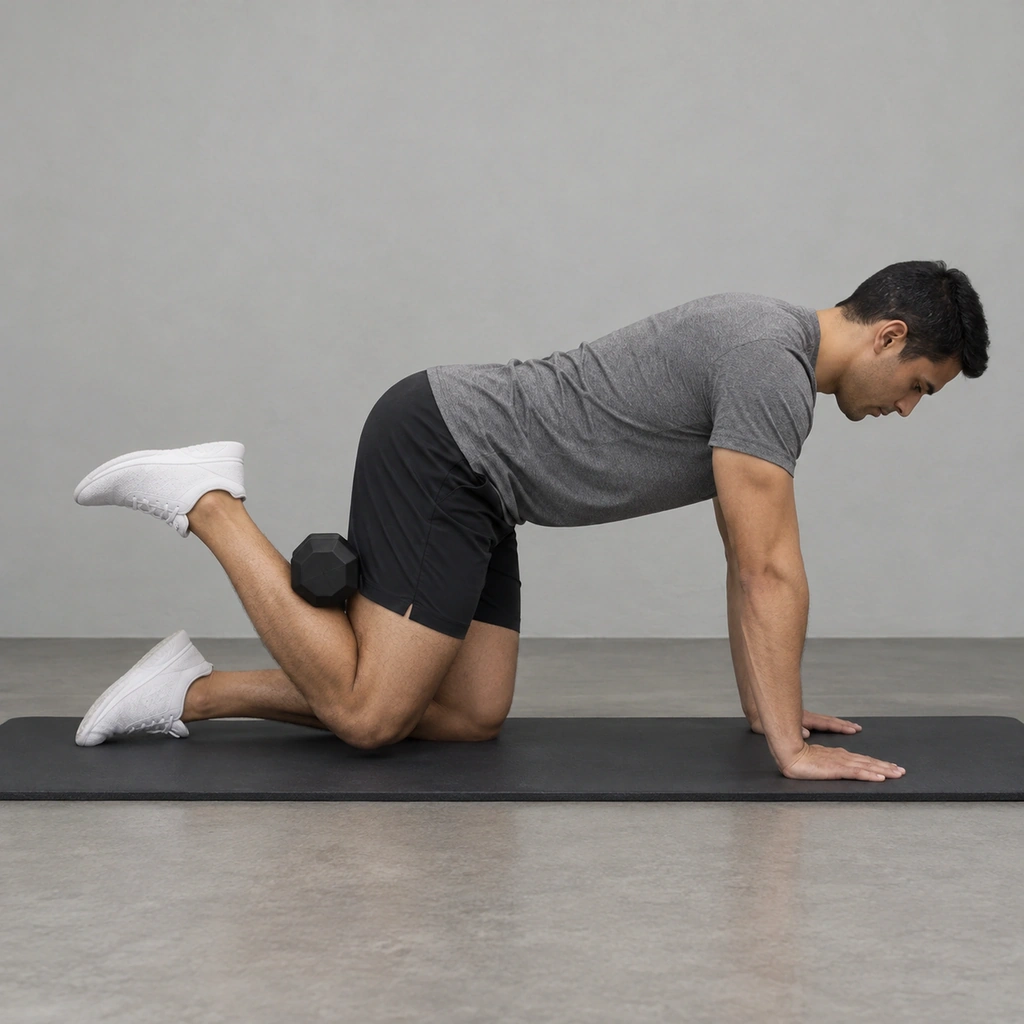
Step 1 of 3
Get on all fours on a mat with your hands under your shoulders and your support knee under your hip. Take a dumbbell and place it behind the knee of the leg you are going to lift, keeping that knee bent at a 90-degree angle so the dumbbell stays trapped in place.
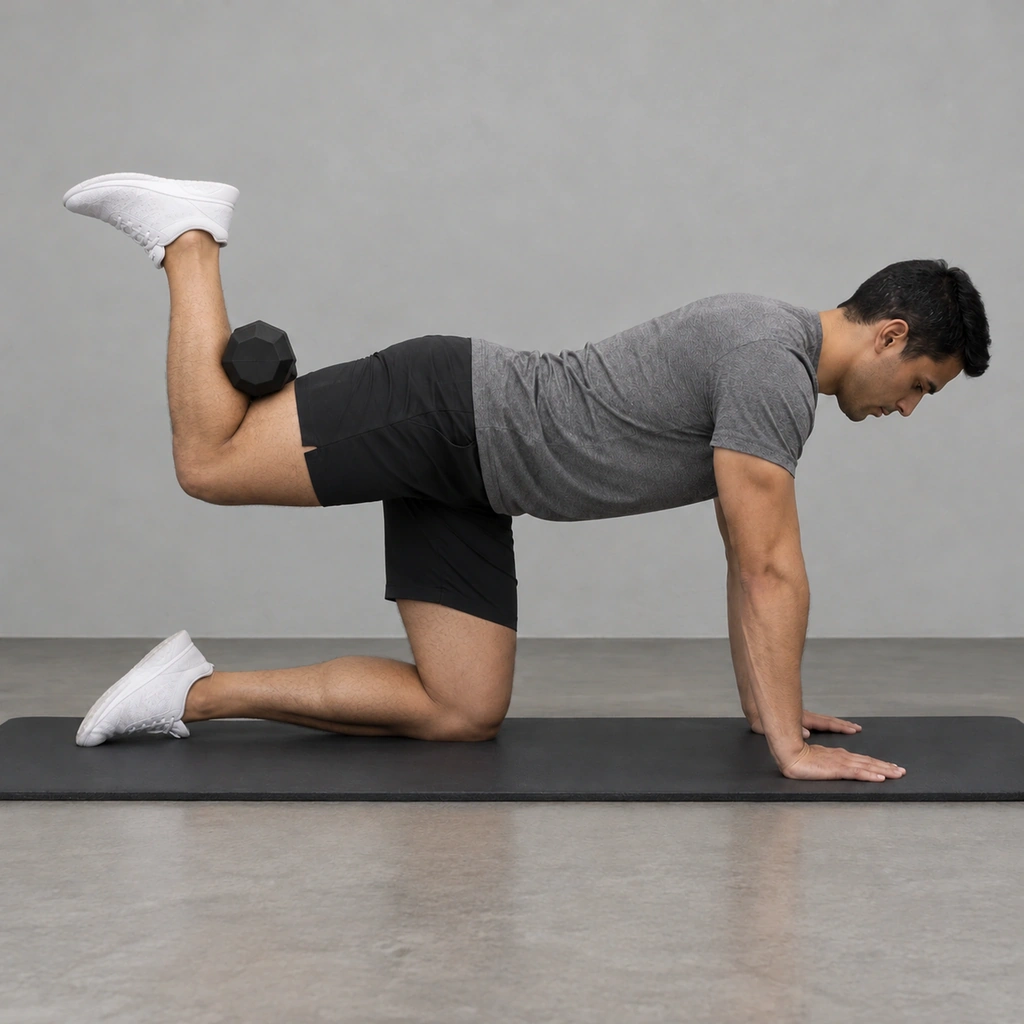
Step 2 of 3
Inhale, then as you exhale, lift the leg with the dumbbell upward, keeping the knee bent at the same 90-degree angle, until your thigh is parallel to the floor. Hold for one second, feeling the contraction in your glutes.
Step 3 of 3
Get on all fours on a mat with your hands under your shoulders and your support knee under your hip. Take a dumbbell and place it behind the knee of the leg you are going to lift, keeping that knee bent at a 90-degree angle so the dumbbell stays trapped in place.
What you should feel
A contraction felt in the glutes at the top of the lift: "Raise the leg until it is parallel to the floor, feeling the contraction in the glutes."
Breathing
- Inhale before lifting, then breathe out as you lift the leg with the dumbbell upward: "Inhale and, as you exhale, lift the leg with the dumbbell upward."
Safety Information
Warning: keep the dumbbell trapped securely behind the working knee throughout every repetition -- do not let it slip or dangle loosely -- because it must be held securely to prevent it from falling during the exercise. If you have a low-back injury, hip injury, wrist injury, or a recent hip or knee surgery, ask a physical therapist or physician before attempting this exercise, because it loads the hip through an added external weight while bearing weight through both wrists in a hands-and-knees position. Raise the leg only until the thigh is parallel to the floor and stop there -- do not lift beyond that point -- because the leg is raised only until it is parallel to the floor, not any higher. Stop if the exercise causes pain or you become unwell. Seek appropriate professional advice about symptoms or suitability.
Get your free personalized program at clapmove.com/register
Printed from clapmove.com. ClapMove is not a replacement for professional medical advice — always consult a healthcare provider before starting any exercise program.